
 24/7 help
 Sign In
 Cart
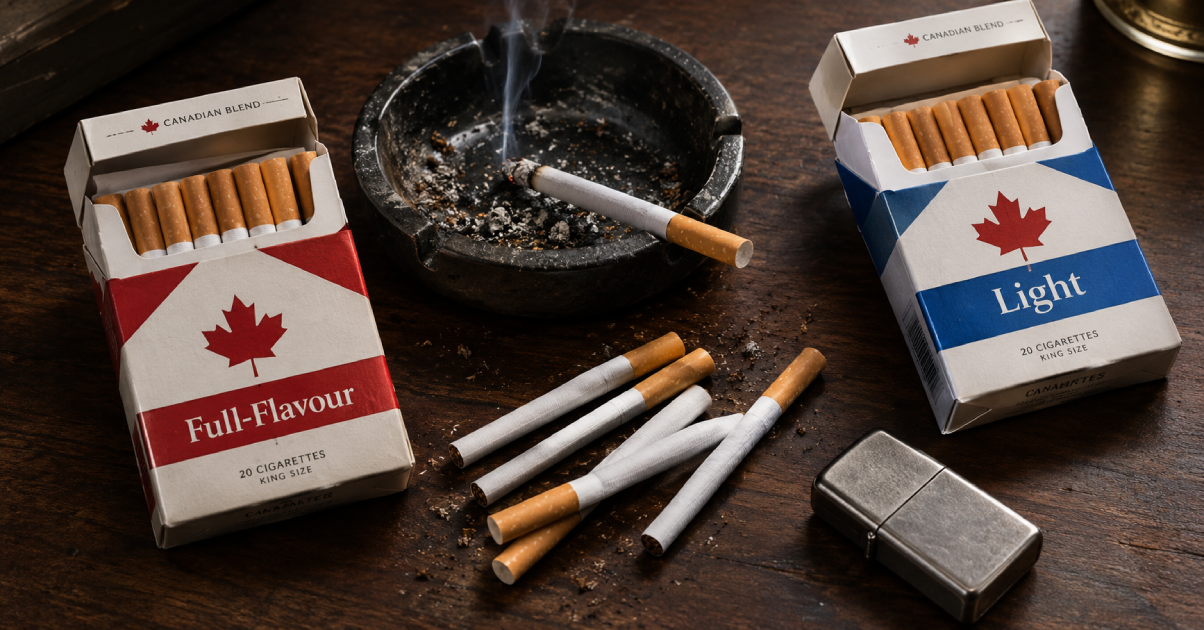
For many years, cigarette packages used terms such as light, mild, regular, smooth, and full flavour to distinguish between different smoking experiences. Although these descriptions sounded simple, they did not represent standardized measures of cigarette strength or health risk.
Historically, light cigarettes were cigarettes designed and marketed to provide a milder-tasting or less intense smoking experience than full-flavour varieties. Differences in tobacco blends, filters, ventilation, and cigarette construction could affect how the smoke tasted and felt.
There is an important distinction for Canadians today: “light” is historical terminology, not a safer category of cigarette. Canadian regulations prohibit the use of “light” and “mild,” including variations of those terms, in the promotion of specified tobacco products.
That means someone searching online for terms such as “light cigarettes,” “Canadian lights,” or “light cigarette brands” may be using terminology they remember from older cigarette packaging rather than terminology found on modern Canadian products.
Most importantly, a cigarette that tastes lighter or smoother should not be interpreted as safer. Public-health authorities have concluded that cigarettes historically marketed as light do not provide a safe alternative to regular or full-flavour cigarettes.
This guide explains what “light cigarettes” historically meant, how they differed from full-flavour varieties, why the terminology changed in Canada, what affects perceived cigarette intensity, and what consumers should understand when encountering these older terms today.
Important: All cigarettes expose smokers to serious health risks. Historical terms such as “light,” “mild,” and “full flavour” describe product positioning and perceived smoking characteristics; they should not be interpreted as measures of safety.
What Were Light Cigarettes?
The term “light cigarettes” was historically used to distinguish cigarettes intended to produce a milder or less intense smoking sensation from traditional full-flavour cigarettes.
This distinction could be created through several elements of cigarette design, including:
- the type and proportions of tobacco used in the blend;
- filter construction;
- filter ventilation;
- airflow and draw resistance;
- cigarette paper and construction; and
- other characteristics affecting how the cigarette burned and how its smoke was perceived.
These factors could influence the cigarette’s aroma, smoke density, tobacco flavour, throat sensation, and overall perceived intensity.
For example, a smoker comparing two varieties within the same historical brand family might have described one as smoother or lighter and the other as richer or stronger.
However, these were largely sensory distinctions.
A cigarette feeling smoother does not establish that it contains fewer harmful substances or exposes the smoker to substantially less risk. This difference between perceived intensity and actual health risk is essential to understanding why the old terminology eventually became controversial.
Are Light Cigarettes Safer Than Full-Flavour Cigarettes?
No.
This is the most important point to understand about cigarettes historically described as light or mild.
A smoother taste, softer throat sensation, or less intense smoking experience does not mean a cigarette is safe or substantially safer than a full-flavour cigarette.
Historically, some cigarettes marketed as light produced lower tar or nicotine yields under standardized machine-testing conditions. Those measurements contributed to the perception that light cigarettes might provide a lower-risk alternative to conventional cigarettes.
Real-world smoking, however, is not the same as machine testing.
People differ in how frequently they puff, how deeply they inhale, how much of a cigarette they smoke, and other smoking behaviours. Filter ventilation and cigarette design can also interact with smoking behaviour in ways that affect actual exposure.
The National Cancer Institute (NCI) states that light cigarettes are no safer than regular cigarettes. It also explains that smokers may receive substantial exposure from cigarettes that produce lower yields under machine-testing conditions.
In other words:
Lighter taste ≠ lower health risk.
The term “light” is therefore best understood as a historical product descriptor associated with perceived smoking intensity, not a health classification.
Why Did Canada Stop Using “Light” and “Mild” Cigarette Descriptors?
The terminology changed because descriptions such as “light” and “mild” could give consumers a misleading impression about health risk.
For decades, the cigarette industry used strength-related terminology to distinguish varieties within brand families. A smoker might have encountered a full-flavour version alongside mild, light, or ultra-light alternatives.
The problem was that consumers could interpret these names as meaning that one cigarette was less harmful than another.
Canadian authorities responded to that concern.
Major Canadian cigarette manufacturers began phasing out “light” and “mild” descriptors in the mid-2000s. Federal regulation subsequently prohibited specified tobacco products from being promoted using the terms “light” and “mild,” including variations of those terms.
As a result, the historical language familiar to longtime smokers is not necessarily the language found on modern Canadian cigarette products.
This explains an apparent contradiction that can confuse people researching cigarettes online:
Consumers may still search for “light cigarettes,” even though modern Canadian products are not officially categorized that way.
The search term survives because people remember it.
What Does “Canadian Lights” Mean Today?
“Canadian lights” is an informal or historical expression rather than an official modern cigarette category in Canada.
Someone using the phrase today may be looking for information about:
- a cigarette they previously knew as a light variety;
- a smoother or less intense tobacco profile;
- an older brand variant whose name or packaging has changed;
- the difference between former light and full-flavour varieties; or
- historical Canadian cigarette terminology.
This distinction matters because old terminology should not automatically be applied to current products.
Modern product names, packaging requirements, and tobacco regulations have changed substantially. A person remembering a particular cigarette from years ago may therefore find that its packaging, variant name, or other identifying characteristics are different today.
For informational purposes, it is more accurate to treat “Canadian lights” as a historical consumer term than as a standardized modern product class.
Light Cigarettes vs. Full-Flavour Cigarettes: What Was the Difference?
Historically, the most noticeable distinction was perceived smoking intensity.
Light-style varieties were generally intended to provide a milder sensory experience, while full-flavour cigarettes were associated with a stronger or more pronounced tobacco profile.
A simplified comparison looks like this:
| Characteristic | Historically “Light” Style | Full-Flavour Style |
| Perceived tobacco intensity | Generally milder | Generally stronger |
| Smoke sensation | Often perceived as lighter | Often perceived as fuller |
| Throat sensation | Typically described as softer | Typically described as more pronounced |
| Tobacco profile | Often more restrained | Often richer or more robust |
| Historical positioning | Lower perceived intensity | Traditional/full intensity |
| Health implication | Not safer | Not safe |
These descriptions are subjective rather than scientific strength ratings.
Two smokers can experience the same cigarette differently. What one person considers smooth, another may consider strong. Previous smoking habits, expectations, tobacco blend, filter design, and individual sensory perception can all affect the experience.
For that reason, terms such as smooth, rich, strong, light, and full flavour are best understood as descriptions of perceived characteristics rather than precise measurements.

What Made Some Cigarettes Taste or Feel Lighter?
Several design characteristics can affect how cigarette smoke is perceived.
Understanding them helps explain why two cigarettes can produce noticeably different sensory experiences even though neither should be considered safer.
1. Tobacco Blend
The tobacco blend is one of the most obvious contributors to a cigarette’s character.
Manufacturers can combine different types and grades of tobacco in different proportions. Tobacco varieties can differ in aroma, body, sweetness, earthiness, and other sensory characteristics.
The way tobacco is grown, cured, processed, and blended also contributes to the final profile.
As a result, one blend may produce a richer or more pronounced tobacco character while another may be perceived as softer or more restrained.
This is also why cigarettes described in similar terms do not necessarily taste alike. There is no universal recipe for a “smooth” or “full-flavour” cigarette.
2. Filter Design
The filter can influence the smoking experience by affecting airflow, resistance, and characteristics of the smoke reaching the smoker.
Different filter materials and constructions can change how a cigarette draws and how dense the smoke feels.
Consequently, two cigarettes with similar dimensions and visually similar filters can still produce different sensory experiences.
3. Filter Ventilation
Filter ventilation played an especially significant role in many cigarettes historically marketed as light.
Ventilation typically involves small openings around the filter or tipping-paper area that allow outside air to mix with cigarette smoke.
That additional air can dilute the smoke stream and contribute to a lighter-feeling or less concentrated sensation.
However, ventilation is also one reason historical machine-generated measurements could be misleading when interpreted as direct measures of a smoker’s exposure.
Smoking machines follow standardized procedures. Human smoking behaviour varies.
The amount of smoke and harmful substances actually inhaled can therefore differ from what older machine-generated yield numbers might have suggested.
4. Draw Resistance and Airflow
The amount of resistance a smoker experiences when drawing on a cigarette can also affect perceived intensity.
Differences in filter construction, ventilation, tobacco packing, and other design elements can change airflow.
A cigarette with a more open draw may feel different from one with greater resistance even if other characteristics are similar.
5. Cigarette Construction
The overall construction of a cigarette matters as well.
Paper, dimensions, tobacco density, filter characteristics, and other physical elements can influence how a cigarette burns and how its smoke is perceived.
Modern Canadian cigarettes are also subject to federal requirements governing aspects of their appearance and packaging. That makes the visual cues historically used to distinguish cigarette varieties less prominent than they once were.
Why Machine-Measured “Tar” and Nicotine Did Not Tell the Whole Story
Understanding historical light cigarettes also requires understanding the limitations of machine testing.
For years, cigarette varieties could be associated with machine-generated tar and nicotine yields. A cigarette producing lower numbers under standardized testing could appear to be a lower-exposure product.
The problem was that those numbers did not necessarily represent how an individual smoked the cigarette.
Humans do not smoke like standardized machines.
A smoker may:
- take larger puffs;
- puff more frequently;
- inhale differently;
- smoke more of each cigarette; or
- otherwise change smoking behaviour.
These differences can substantially affect exposure.
That is why lower machine-generated numbers should not be interpreted as proof that historically light cigarettes provided proportionately lower health risks.
It is also one reason the simple hierarchy implied by labels such as ultra-light → light → mild → regular could be misleading.
What Does “Full Flavour” Mean?
Full flavour traditionally describes a cigarette associated with a richer, stronger, or more pronounced tobacco-smoking experience.
It does not refer to one standardized tobacco blend or construction.
Depending on the product and brand, a full-flavour cigarette may be perceived as having:
- greater tobacco body;
- a more noticeable throat sensation;
- denser-feeling smoke;
- a stronger aroma; or
- a more persistent tobacco finish.
But one manufacturer’s full-flavour variety may taste very different from another manufacturer’s version.
The final experience depends on the tobacco, blend, processing methods, filter, dimensions, ventilation, and overall cigarette design.
That makes full flavour a sensory description, not a scientific measurement of cigarette strength or risk.
Does “Smooth” Mean the Same Thing as “Light”?
Not necessarily.
“Smooth” generally describes a sensory impression: the smoke may be perceived as less harsh, more balanced, or softer on the throat.
Historically, a light cigarette might also have been described by smokers as smooth, but the two terms are not technically interchangeable.
A cigarette could be perceived as smooth while still having a relatively noticeable tobacco flavour. Similarly, two cigarettes could both be considered mild in perceived intensity while having very different tobacco profiles.
The safest way to interpret sensory language is exactly as that: a description of perceived taste or sensation, not an indication of reduced health risk.
What Are Premium Cigarettes?
The term premium cigarettes describes a different concept from historical strength classifications.
“Light” traditionally referred to perceived intensity.
“Premium” generally refers to a product’s market positioning, brand identity, tobacco selection, manufacturing approach, or reputation.
A premium cigarette therefore does not have to be full-flavoured.
Depending on the brand family, premium varieties may emphasize different characteristics, including:
- tobacco blend;
- aroma;
- balance;
- smoothness;
- stronger tobacco character; or
- distinctive brand-specific profiles.
This means the following terms answer different questions:
Light — historically described perceived intensity.
Full flavour — generally describes a stronger or more pronounced sensory profile.
Premium — generally describes market positioning and product characteristics rather than a specific intensity level.
None of these terms should be treated as a health-risk classification.

How Canadian Cigarette Packaging Has Changed
Another reason historical cigarette terminology can be confusing is that Canadian tobacco packaging has changed dramatically.
Older cigarette packages could use branding, colours, logos, and strength descriptors to help distinguish one variety from another.
Canada now has extensive federal tobacco appearance, packaging, and labelling requirements.
These rules have significantly standardized the appearance of tobacco packages and products and require prominent health-related information.
Canada has also introduced health warnings directly on individual cigarettes. Implementation of these requirements has occurred in stages under federal tobacco appearance, packaging, and labelling regulations.
The result is a marketplace in which consumers cannot rely on many of the same visual and descriptive cues that were common decades ago.
For someone returning to a brand after a long period, the current package may therefore look very different from what they remember.
A Short Timeline of “Light” Cigarette Terminology in Canada
Understanding the regulatory history makes today’s terminology easier to follow.
Before the mid-2000s
Terms such as light, mild, and ultra-light were widely familiar as cigarette variant descriptors. Different variants were frequently distinguished using names, colours, and packaging designs.
2006–2007
Major Canadian cigarette manufacturers began phasing out “light” and “mild” descriptors following concerns that the terminology could cause consumers to perceive some cigarettes as less harmful.
2011
Federal Promotion of Tobacco Products and Accessories Regulations (Prohibited Terms) established restrictions involving the use of “light” and “mild,” including variations of those terms, in the promotion of specified tobacco products.
2019 onward
Canada introduced extensive standardized appearance requirements for tobacco products and packages, further changing how cigarette brands and variants could be presented.
2023 onward
Canada’s Tobacco Products Appearance, Packaging and Labelling Regulations consolidated and updated major federal requirements and introduced health warnings directly on individual cigarettes, with implementation occurring according to regulatory timelines.
Today
“Light cigarettes” remains recognizable historical terminology, particularly in consumer searches and discussions, but it should not be interpreted as an official modern Canadian product category or as an indication of reduced health risk.
How to Interpret Historical Cigarette Names Today
People who remember older cigarette brands may naturally continue using the terminology that was familiar at the time.
Someone might remember buying a brand’s “light” version and later search for that exact phrase even though the modern product lineup uses different identifiers.
That does not mean every current cigarette can or should be assigned an unofficial “light,” “mild,” or “full-flavour” equivalent.
Product formulations, brand families, packaging, and regulations can change over time.
When researching historical products, it is therefore useful to separate three questions:
What was the product historically called?
This can establish which variant a smoker remembers.
What did that descriptor historically communicate?
Usually, terms such as light or mild referred to perceived smoking intensity and product positioning.
Does the historical descriptor establish health risk?
No. A cigarette’s historical classification as light should not be interpreted as evidence that it was safer.
Keeping these questions separate avoids one of the biggest sources of confusion surrounding historical cigarette terminology.
Understanding Cigarette Information Online
Online information about cigarettes can use a mixture of current and historical terminology.
This is especially true when people discuss older brand variants or use familiar expressions such as “Canadian lights.”
Readers should therefore pay attention to context.
If a website uses the word “light” while discussing the history of cigarette marketing or explaining old terminology, the term serves an informational purpose.
That is different from assuming that “light” represents a modern standardized health or safety category.
Adult consumers researching Canadian cigarette products should also consider whether information is current and whether regulatory or health claims are supported by authoritative sources.
For tobacco regulations, Health Canada and the Government of Canada should be primary references.
For health information concerning cigarettes historically marketed as light, public-health authorities such as the National Cancer Institute provide useful evidence-based guidance.
Researching Cigarette Terminology With Save on Cigarettes
Save on Cigarettes provides adult Canadian customers with access to information about available cigarette products and brand families.
Because historical cigarette terminology has changed, people researching products through Save on Cigarettes may encounter current product identifiers that differ from names or package designs they remember from previous years.
The important distinction is that historical terms such as “light” should be used to understand older terminology and perceived smoking characteristics—not to imply that one cigarette presents a safer smoking option than another.
When researching current products, adult consumers should rely on lawful current product information and recognize that subjective characteristics such as smoothness, richness, and perceived intensity can vary from person to person.
All tobacco purchases must comply with applicable federal, provincial, and territorial requirements, including legal-age requirements.
Frequently Asked Questions About Light Cigarettes
What were light cigarettes?
Light cigarettes were historically cigarette varieties marketed as providing a milder or less intense smoking experience than regular or full-flavour varieties. Differences in tobacco blend, filter design, ventilation, airflow, and overall construction could contribute to this perception.
Are light cigarettes safer than regular cigarettes?
No. A lighter taste or smoother smoking sensation does not make a cigarette safe. The National Cancer Institute states that light cigarettes are no safer than regular cigarettes.
Can cigarettes be called “light” in Canada?
Canadian federal regulations prohibit the terms “light” and “mild,” including variations of those terms, in the promotion of specified tobacco products. The term is therefore best understood in a historical or explanatory context rather than as an official modern Canadian cigarette category.
What does “Canadian lights” mean?
“Canadian lights” is an informal expression that may be used when referring to Canadian cigarette varieties historically associated with lighter or milder perceived smoking characteristics. It is not a standardized modern health or product classification.
What is the difference between light and full-flavour cigarettes?
Historically, the main distinction involved perceived intensity. Light varieties were generally positioned as milder or less intense, while full-flavour cigarettes were associated with a richer or stronger tobacco-smoking experience.
That sensory difference did not establish that light cigarettes were safer.
What makes a cigarette feel lighter?
Several factors can affect perceived intensity, including tobacco blend, filter construction, ventilation, draw resistance, airflow, and overall cigarette construction.
Does a smoother cigarette contain less nicotine?
You cannot reliably determine nicotine exposure simply from how smooth or strong a cigarette tastes. Sensory intensity and actual exposure are not the same thing, and individual smoking behaviour also affects exposure.
Does “smooth” mean “light”?
Not necessarily. Smoothness is a subjective description of how smoke feels or tastes. It should not be interpreted as a standardized strength category or reduced-risk claim.
Are premium cigarettes the same as full-flavour cigarettes?
No. “Premium” generally refers to brand positioning, tobacco selection, manufacturing characteristics, or product reputation. A premium brand can have different sensory profiles and is not automatically full-flavoured.
Why were light and mild cigarette descriptors removed?
Public-health authorities were concerned that terms such as “light” and “mild” could lead consumers to believe certain cigarettes were less harmful. Canadian regulations subsequently restricted these descriptors in tobacco promotion.
Why do people still search for light cigarette brands?
The terminology was familiar for many years. People may continue using historical names when researching a cigarette they remember, trying to understand an older brand variant, or looking for information about differences in perceived cigarette intensity.
The Bottom Line on Light vs. Full-Flavour Cigarettes
The meaning of “light cigarettes” is easiest to understand when the term is placed in its historical context.
Light cigarettes were traditionally designed and marketed to provide a milder or less intense perceived smoking experience than full-flavour varieties. Tobacco blends, filters, ventilation, airflow, and overall construction could all contribute to those sensory differences.
What the word “light” did not establish was safety.
A smoother sensation or less intense tobacco taste does not make cigarette smoking safe, and cigarettes historically marketed as light should not be viewed as reduced-risk alternatives to regular or full-flavour cigarettes.
That distinction is also central to understanding why Canadian cigarette terminology changed. Concerns that terms such as “light” and “mild” could mislead consumers contributed to their removal from tobacco promotion, while broader Canadian tobacco regulations have substantially changed cigarette packaging and labelling.
Today, expressions such as “light cigarettes,” “Canadian lights,” and “light cigarette brands” are best understood as historical or informal terminology. They can help explain how products were once differentiated and why consumers may remember certain varieties in particular ways, but they should not be used as measures of health risk.
For adults researching current Canadian cigarette products through Saveoncigs.com, the most useful approach is to distinguish historical terminology from current product information and to consult authoritative sources when evaluating regulatory or health claims.
References:
Pelling, N. J. (n.d.). The Nature of Tobacco and Cigarette Information on the Internet. Academia.edu. Available at: https://www.academia.edu/116922344/The_Nature_of_Tobacco_and_Cigarette_Information_on_the_Internet
StoryMD. (n.d.). Light Cigarettes and Cancer Risk: Are Light Cigarettes Less Hazardous Than Regular Cigarettes? Available at: https://storymd.com/journal/wlyr57xhem-light-cigarettes-and-cancer-risk/page/be5vo8inrdk2-are-light-cigarettes-less-hazardous-than-regular-cigarettes
Jewell, T. (Medically reviewed by Adithya Cattamanchi, M.D.). (November 18, 2019). How Much Nicotine Is in a Cigarette? Healthline. Available at: https://www.healthline.com/health/how-much-nicotine-is-in-a-cigarette
Dr. Leslie Lars Iversen, CBE FRS MAE